Mobility Aids for Elderly Parents: A Family Guide
When a parent starts to struggle with getting around, it can be difficult to know how to help. Mobility problems often develop gradually, and many older people resist asking for help or worry about losing independence. As a family member, your role is to open the conversation, understand the options, and help find a solution that works for them, not just one that seems practical from the outside.
This guide covers the main types of mobility aid available in the UK, how to assess what your parent actually needs, and what financial support might be available to make it affordable.
Start with an Assessment
Before buying anything, it is worth understanding exactly where the difficulties lie. Is your parent unsteady on their feet? Do they get out of breath walking short distances? Are they struggling with stairs? The answer shapes what kind of help will make the most difference.
An occupational therapist (OT) assessment is invaluable here. OTs are trained to identify mobility challenges and recommend appropriate aids and home adaptations. You can request an assessment through your parent's GP, or through their local authority social services team. Some areas have waiting lists, so it is worth exploring this early.
Walking Aids
For many older people, the first step is a straightforward walking aid. The right choice depends on how much support is needed and how it will be used.
- Walking stick: Provides light support and balance assistance. Best for those who are slightly unsteady but still largely independent. A ferrule (rubber tip) should be checked regularly for wear.
- Elbow crutch: More stable than a stick, useful after injury or surgery.
- Zimmer frame (walking frame): Four legs and a wide base give significant support. Standard frames must be lifted to move; wheeled versions roll forward more easily.
- Rollator: A wheeled walker with a seat, basket and hand brakes. Ideal for people who tire quickly and need to stop and rest. Popular for outdoor use.
- Gutter frame: Forearm support for those with weak grip or wrist problems.
Walking aids are generally inexpensive, with sticks costing from under £10 and rollators from around £50. They may also be loaned by the NHS following a hospital admission or via a community equipment service.
Wheelchairs
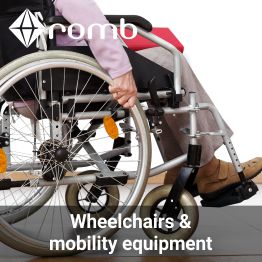
If your parent cannot walk safely or at all, a wheelchair may be the answer. Manual wheelchairs are pushed by a carer or self-propelled by the user. Self-propelled models have large rear wheels that the user pushes; attendant-controlled models have four smaller wheels and are designed to be pushed by someone else.
Transit wheelchairs are lightweight and fold for car boot transport, making them good for day trips and appointments. Standard self-propelled models are heavier but give the user more independence at home.
If your parent has enough strength and coordination, a powered (electric) wheelchair offers independent movement without relying on a carer. The NHS provides powered wheelchairs to those who meet clinical criteria through the wheelchair service, accessed via GP referral.
Mobility Scooters
A mobility scooter is a good option for parents who can sit unsupported and want to get out and about independently. Scooters are particularly popular for shopping, visiting friends, or getting to community activities.
Travel scooters disassemble into boot-sized pieces for easy transport, while larger Class 3 models can travel at up to 8 mph on the road and cover 30-40 miles on a charge. Scooters are not available through the NHS but are eligible under the Motability Scheme for those receiving higher rate PIP or DLA mobility component.
Home Adaptations
Mobility aids are not just about getting from A to B. Many families also find that adaptations to the home make a big difference to daily safety and independence.
- Grab rails: Fitted in bathrooms, by steps, and along hallways. Inexpensive and highly effective at preventing falls.
- Stairlift: Allows continued access to all floors without climbing stairs. Straight models start around £1,800; curved models cost more.
- Ramp: Replaces steps at entrances to allow wheelchair or scooter access.
- Raised toilet seat: Reduces the effort needed to sit down and stand up.
- Bath lift or shower seat: Maintains bathing independence with reduced fall risk.
Funding and Financial Support
The cost of mobility aids and adaptations can add up. Fortunately, there are several sources of financial help in the UK.
- Disabled Facilities Grant: Up to £30,000 from the local council for home adaptations, means-tested, accessed via an OT assessment.
- VAT exemption: Most mobility aids are zero-rated for VAT when purchased by someone with a disability or long-term illness.
- Motability Scheme: Allows eligible people to lease a scooter or powered wheelchair using their mobility benefit.
- NHS equipment: Walking aids, manual and powered wheelchairs, and some other equipment may be provided free on loan via community equipment services.
- Charitable grants: Organisations including Age UK, Turn2us, and condition-specific charities sometimes offer financial support for mobility equipment.
Having the Conversation
Perhaps the hardest part of helping an elderly parent with mobility challenges is getting them to accept help in the first place. Many older people fear that using a mobility aid signals a loss of independence or capability. In reality, the right aid does the opposite: it extends independence and reduces the risk of falls or accidents.
Frame the conversation around what they want to be able to do, not what they can no longer manage. If your mum misses walking to the shops, a rollator or scooter gives that back. If your dad is nervous on the stairs, a stairlift means he can stay safely in the home he loves. Focusing on gains, not losses, makes the conversation much easier for everyone.